Dining table centerpiece ideas for every occasion and budget
Affiliate Disclosure: DecorDesignIdeas.com is a participant in the Amazon Services LLC Associates Program, an affiliate advertising program designed to provide a means for sites to earn advertising fees by advertising and linking to Amazon.com.
As an Amazon Associate, we earn from qualifying purchases. This comes at no extra cost to you.
A dining table without something in the middle is a workstation. Four legs, a flat surface, and whatever dishes landed there. A centerpiece is not a formality. It is a decision that the table is for sitting, not only for stacking.
The word sounds dressy. A bowl of lemons still counts. So does one plant in terracotta. The job is to put something in the middle that is not the salt.
DecorDesignIdeas Editorial treats the centerpiece as a conversation sightline. We compare Homes & Gardens entertaining notes, BHG low-arrangement write-ups, and what actually leaves room for a platter. This desk does not stage dinner parties, and we do not invent a “perfect 12-inch” lab height.
Holiday-scale tables live in holiday table decorating ideas. The walls around the table are in dining room wall decor ideas. Fixture height over the same table is in dining room lighting ideas.
Listing check: vase, runner, and candle links below are tagged Amazon searches we use to compare listed height and vessel width. We are not copying Amazon “dinner-party ready” copy. Sit in the chair before you order.
Before you buy a vessel
Sit where a guest will sit. Look across the table. If you cannot see the face opposite you, the arrangement is too tall no matter what the listing says.
- Do the chair test. Homes & Gardens quotes entertaining voices on this exact check: sit down; if you cannot see the person across, cut the stems or move the tower to the buffet.
- Measure the leftover top. Place settings plus serving dishes need a ring of table. A centerpiece that eats the platter lane forces everyone to pass food around a hedge.
- Pick a lift plan. Everyday pieces should move in one motion. A tray or a low bowl beats five objects you have to relocate before Tuesday pasta.
- Smell the flowers in the store. Lilies, hyacinths, and gardenias compete with food. Save the heavy scent for the entry or the living room.
- Check flame clearance. Real candles next to a grocery-store eucalyptus runner need air. If kids, pets, or a low pendant share the table, use LED pillars.
Portmeirion’s published “9-inch vase” note, as quoted in Homes & Gardens, is one retailer’s conversation-height example, not a number this desk measured. Your chairs and your stems are the test.
When to skip a centerpiece
| Idea | Do it when | Skip it when |
|---|---|---|
| Everyday three-object cluster | Table is also a display between meals and you will lift it for dinner | The table is homework HQ every night; keep a tray in the sideboard |
| Low grocery bouquet | You have 15 minutes and a wide, short vessel | The only vase you own is a tall cylinder that forces stems to 18 inches |
| Garland plus candles | The table is long and you can keep flame off the greens | A low pendant already sits in the same air, or the runner is dry |
| Tall candelabra / urn | Buffet, console, or mantel | The dining table, unless the stems are skinny enough to see through |
| Strongly scented flowers | Entry, powder room, living room | Next to dinner |
| Silk rose bouquet | Never, if you want the table to look considered | Use fruit, candles, or a real plant instead |
| Nothing at all | Rare. A single candle still counts | Only when the table has to disappear for a project |
A table that is also the desk should not wear a tablescape all week. Park the tray in the sideboard. The same “usable surface” logic on a smaller top is in end table decor ideas.
The height rule
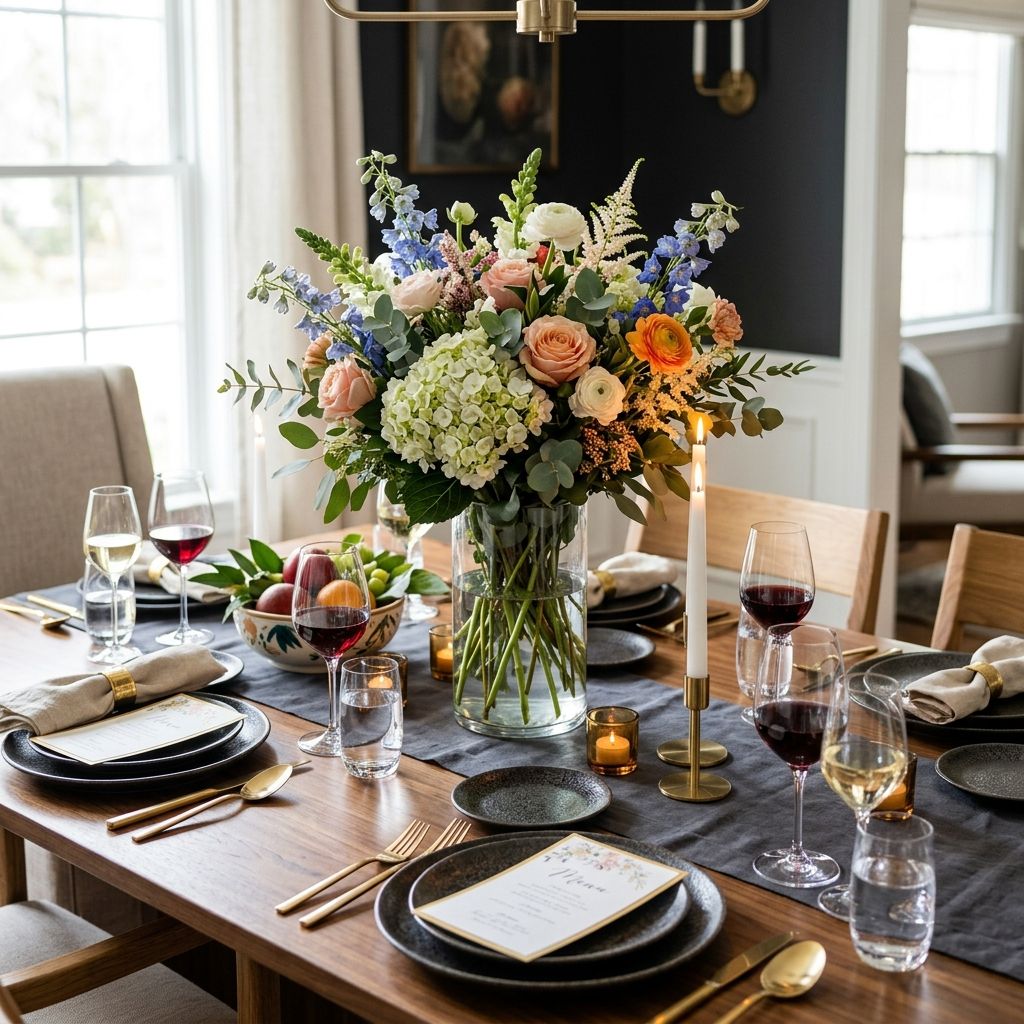
Centerpieces at a dining table should sit below the seated eyeline, or go so skinny you can see through them. BHG’s holiday-table notes keep repeating the same idea: go low so conversation stays open. Homes & Gardens is blunter: test from the chair.
That eliminates the gladiola tower, the three-foot candelabra, and the oversized urn. Those belong on a buffet, a console, or a mantel. Not between two people trying to talk.
Exceptions this desk allows: tall, thin tapers in low holders (you see between them), and single-stem bud vases. A 9-inch vase with short stems is a starting shop filter, not a guarantee.
Desk note: “12 to 14 inches tall” is a common blog band because it sits under most seated eye lines. It is not a measurement we took on your chairs. If a guest has to lean, cut the stems.
Everyday centerpieces (the “set it and forget it” tier)
These stay on the table between meals. Low effort. Easy to lift.
The three-object cluster
Three items, slightly different heights, kept in a tight zone:
- One organic element — a small potted plant, a bowl of fruit, or a vase with one branch
- One functional item — a candle, a salt cellar, or a small tray
- One decorative piece — a ceramic bowl, a wood object, something you would leave out if a guest picked it up
Keep the grouping tight: about a 12-inch circle on a round table, a 12×18-inch zone on a rectangle. Spread across the whole top and it reads as abandoned, not arranged.
The single statement
One item, chosen on purpose:
- A wide ceramic bowl of seasonal produce (lemons, small pumpkins, pinecones)
- A low succulent in a shallow planter
- A wooden dough bowl with moss or stones
This is the right call on a table that seats four or fewer.
The runner plus objects
A linen or cotton runner defines the zone and protects the wood.
Lay the runner. Put a candle at each end and one low plant or vase in the middle. The runner ties unrelated objects together.
Browse linen table runners and check listed length against the table minus about 6–8 inches of overhang at each end.
Dinner party centerpieces (the “I spent 20 minutes on this” tier)
Guests are coming. You want the table to look considered without a florist invoice.
The low floral arrangement
Buy one grocery bouquet ($8 to $15). Cut stems short (6 to 8 inches). Drop them in a low, wide vessel: a ceramic bowl, a tureen, a wood box. Fan outward so the arrangement stays low and wide.
Separate the bouquet into two or three colors and tuck greenery between clusters. That is the whole “it looks arranged” trick.
Bud vase collection
Three to five small bud vases (thrift stores still sell these cheap) each with one stem. Vary heights between about 4 and 8 inches. Same flower for cohesion, or mixed wildflowers if you want it looser.
Space them 4 to 6 inches apart down the center. Homes & Gardens’ tablescape notes like this “see through the stems” move for a reason: it is a meadow, not a hedge.
Browse small glass bud vase sets and read the listed height. If the vase is already 10 inches before the stem, it will fail the chair test.
Candles and greenery
A loose line of eucalyptus, olive, or rosemary down the center. Tuck pillars or votives at intervals.
Cost band: a bunch of eucalyptus ($5 to $8) plus a three-pillar set ($6 to $10) is a current grocery / marketplace range, not a receipt we kept.
Fire: keep real flame off the greens. LED pillars if kids, pets, or a low fixture share the air. Browse flameless LED pillar candles with timers and check listed diameter against the runner, not the glowing lifestyle shot.
The same warm layer from the ceiling is in dining room lighting ideas.
Holiday and special occasion centerpieces
Thanksgiving and fall
- A wooden tray or board as the base
- Mini pumpkins and gourds in a short color story (white, orange, sage)
- Dried leaves, cinnamon sticks, or pinecones as scatter, not a pile
- Tapers in low holders
Keep it low. Joanna Gaines’ published Thanksgiving note, as reported in Homes & Gardens, is the same chair test: guests should see each other, and there should be room for the food.
Christmas and winter
- A bed of evergreen (yard cuttings or a cheap lot bundle)
- Pillar candles in white, cream, or one metal
- A few ornaments in one or two colors, not the whole box
- Cranberries in a glass cylinder as a color hit
Spring
- A low basket of potted bulbs (hyacinths, muscari, small daffodils)
- If you use hyacinths, know they are fragrant; some tables cannot take that next to food
- Short-stem tulips in a clear vase
Summer
- Citrus in a clear or wood bowl
- Herb pots you will actually pinch for drinks: rosemary, basil, mint
- Wildflowers in mason jars or plain glass
Dessert-table overflow is a different surface in dessert table ideas on a budget.
Choosing vessels
The container does as much work as what is in it.
| Table style | Vessels that sit quietly |
|---|---|
| Farmhouse / rustic | Wood boxes, galvanized metal, mason jars, stoneware |
| Modern | Ceramic cylinders, matte glass, concrete |
| Traditional | Clear glass, silver, brass, porcelain |
| Eclectic | Thrifted mixes with a patina |
One rule: the vessel should not fight the table. Beautiful wood wants a quiet container. A plain table can take a louder pot.
Scaling for table size
Round tables (seats 4 to 6)
One centered arrangement. Keep the footprint compact so plates still fit. Homes & Gardens’ Seb Bishop note: a round table can take a single taller piece if you can see through it. A dense 16-inch hedge still fails.
Rectangular tables (seats 6 to 8)
A centered cluster or a line down the middle. The runner approach earns its keep here.
Long tables (seats 8+)
Repeat the pattern. Three similar clusters, or a continuous low garland. One small bowl at one end of a 10-foot table looks lonely, not refined.
Related Guides
- Dining room lighting ideas, fixture height over the same table
- Dining room wall decor ideas
- Holiday table decorating ideas
- Dessert table ideas on a budget
- Kitchen island decor and styling, keep the tall florist work off the chop top
- Console table decor, where the oversized urn actually belongs
Sources
- Chair-test and conversation height: Homes & Gardens, What are the rules for a table centerpiece? (includes Portmeirion’s 9-inch vase example as published there)
- Low holiday arrangements so guests can see each other: Better Homes & Gardens, Table Centerpiece Ideas
- Keep-it-low Thanksgiving note as reported in Homes & Gardens on Joanna Gaines’ Thanksgiving centerpiece
Bottom Line
Sit down. If you cannot see the person across the table, the centerpiece failed, even if it photographs well. Go low, or go skinny enough to see through. Leave a lane for the platter. Lift the everyday cluster in one move when dinner starts.