Dining room wall decor ideas that actually make a difference
Affiliate Disclosure: DecorDesignIdeas.com is a participant in the Amazon Services LLC Associates Program, an affiliate advertising program designed to provide a means for sites to earn advertising fees by advertising and linking to Amazon.com.
As an Amazon Associate, we earn from qualifying purchases. This comes at no extra cost to you.
Most dining rooms have the same problem: four walls that do nothing. The table gets all the attention during setup, but once people sit down, they face the walls. Those walls set the mood for every meal, every gathering, every morning coffee. Yet they tend to stay blank far longer than any other room in the house.
DecorDesignIdeas Editorial treats dining walls as a seated sightline. We compare Artfully Walls’ dining-height note, this site’s 57-inch standing gallery rule, and what you actually see from the chair. This desk does not hang rooms for a living, and we do not invent a “always 48 inches” lab.
Here are wall treatments that work in real dining rooms, not just in staged photos.
The table in the middle of the same room is in dining table centerpiece ideas. Fixture height over that table is in dining room lighting ideas. Cheap frames that still read as art are in budget wall decor ideas.
Listing check: ledge, wallpaper, and shelf links below are tagged Amazon searches we use to compare listed length and repeat. We are not copying Amazon “statement wall in an hour” copy. Sit in the chair before you order.
Before you hang anything
Sit where a guest will sit. Look at the wall you will face. Standing in the doorway is the wrong test.
- Do the chair test. Artfully Walls’ published dining note drops the center to about 52–57 inches because most viewing happens seated. This site’s gallery wall layout still uses 57 inches for standing rooms. In a dining room, sit down. If you have to crane, drop the grouping.
- Measure the furniture below. Above a buffet or sideboard, leave about 6–10 inches between the top and the bottom of the frame. A piece that floats a foot and a half up looks lost.
- Size to the table or the sideboard, not the empty wall. Two-thirds to three-quarters of the furniture width is a shop filter, not a promise. Tape paper to the wall and sit again.
- Check what a mirror will show. Opposite a window is useful. Opposite a cluttered kitchen counter is a second mess.
- Smell the finish. Candle soot and cooking film settle on dining walls. Open-weave baskets and unsealed limewash near a kitchen pass-through need a wipe plan.
When to skip a wall “upgrade”
| Move | Do it when | Skip it when |
|---|---|---|
| Standing-height gallery (57–60” to center) | The wall is seen from a hallway while walking | The only viewers are in chairs; drop it and sit-test |
| Full wallpaper room | The dining room is its own room and you like the pattern at breakfast | An open-plan wall you cannot isolate; start with one face |
| Wood slats or board-and-batten | You can hit studs or accept adhesive limits, and you will caulk | A rental; use peel-and-stick or a no-nail gallery instead |
| Large mirror | It reflects the table or a window | It reflects the sink pile or a blank ceiling |
| Floating shelves with objects | You will leave a pause on each ledge and dust them | A “30% empty” pie chart you cannot defend; if it looks like storage, take something off |
| Basket wall | The wall is dry and away from the range plume | Above a pass-through that greases everything |
Renters who cannot nail can start with no-nail gallery wall command strips or apartment decorating ideas on a budget.
Gallery walls that tell a story
A grid of matching frames stopped being interesting around 2019. The gallery walls that hold attention now mix materials, scales, and subjects. Layout patterns and spacing rules are in gallery wall layout ideas. Renters can skip the nails with a no-nail gallery wall.
How to build one that looks collected, not cluttered
Start with an anchor piece. This is the largest item on the wall, usually off-center, placed at seated eye level. Build outward from there. Mixing thrifted vintage wood frames with sleek black modern ones adds instant character. Learn more about balancing eras in how to mix modern and vintage decor. Weekend paint geometry is in DIY accent wall ideas under $50.
Mix these elements for depth:
- One oversized frame (the anchor)
- Two to three medium pieces in different frame finishes
- A small mirror or metallic object to bounce light
- One three-dimensional item: a small shelf, a woven basket, or a ceramic plate
Keep spacing between pieces tight, around 2 to 3 inches. Wider gaps make small groupings look scattered rather than intentional.
Desk note: “48 to 52 inches to the center” is a seated starting band, not a measurement we took on your chairs. Sit. If the grouping sits above your eyeline, drop it.
Shelf-and-frame combos
Slim picture ledges solve the commitment problem. You can swap prints seasonally, layer smaller frames in front of larger ones, and tuck in postcards or dried stems without putting another hole in the wall.
Install a single ledge at seated eye level, or stack two with about 12 inches between them. The lower ledge holds your taller pieces; the upper one takes smaller items.
Browse picture ledge shelves and check listed length against the wall run above the sideboard.
Accent walls that anchor the room
An accent wall gives the dining area its own identity, which matters most in open-plan homes where the dining area shares space with the kitchen or living room.
Bold paint
A single wall in deep teal, forest green, burnt orange, or navy creates immediate contrast without overwhelming the room. The darker wall recedes slightly, which can make the room feel deeper than it is.
A few tones that work well behind a dining table:
- Sage green pairs with wood tones and brass hardware
- Charcoal makes white dinnerware and lighter furniture stand out
- Rust or terracotta adds warmth to rooms with a lot of gray or white
Limewash and plaster finishes
Flat paint gives you a color. Limewash gives you movement. The chalky, uneven texture catches light at different angles throughout the day, which means the wall shifts in appearance between morning coffee and evening dinner.
A single gallon of limewash paint covers about 200 square feet on a typical label. Apply it with a damp brush or sponge in random, overlapping strokes. The imperfection is the point. Near a steamy kitchen, confirm the finish can take a wipe.
Wood slats and paneling
Vertical wood slats bring architectural weight to a flat wall. Fluted panels (with rounded ridges) read more contemporary. Flat slat panels with visible spacing between each piece lean more Scandinavian.
For a budget approach, use 1x2 pine strips from a home center, stained or painted, attached with construction adhesive and brad nails. Space them about 1.5 inches apart. A typical 8-foot-wide wall needs around 30 to 35 strips and costs roughly $50 to $80 in materials.
Wainscoting and board-and-batten
Chair-rail-height wainscoting (about 32 to 36 inches from the floor) adds a traditional layer and also protects the lower wall from chair scuffs. Paint the wainscoting a slightly different shade from the upper wall for contrast, or go bold with a two-tone approach: dark on the bottom, lighter on top.
Board-and-batten is essentially vertical strips over a flat surface, installed with liquid nails and finished with caulk and paint. It works in both traditional and modern dining rooms depending on strip width and spacing. Wider strips with more space between them feel more contemporary.
Living-room accent materials that can migrate here are in accent wall ideas for the living room.
Mirrors and how to place them
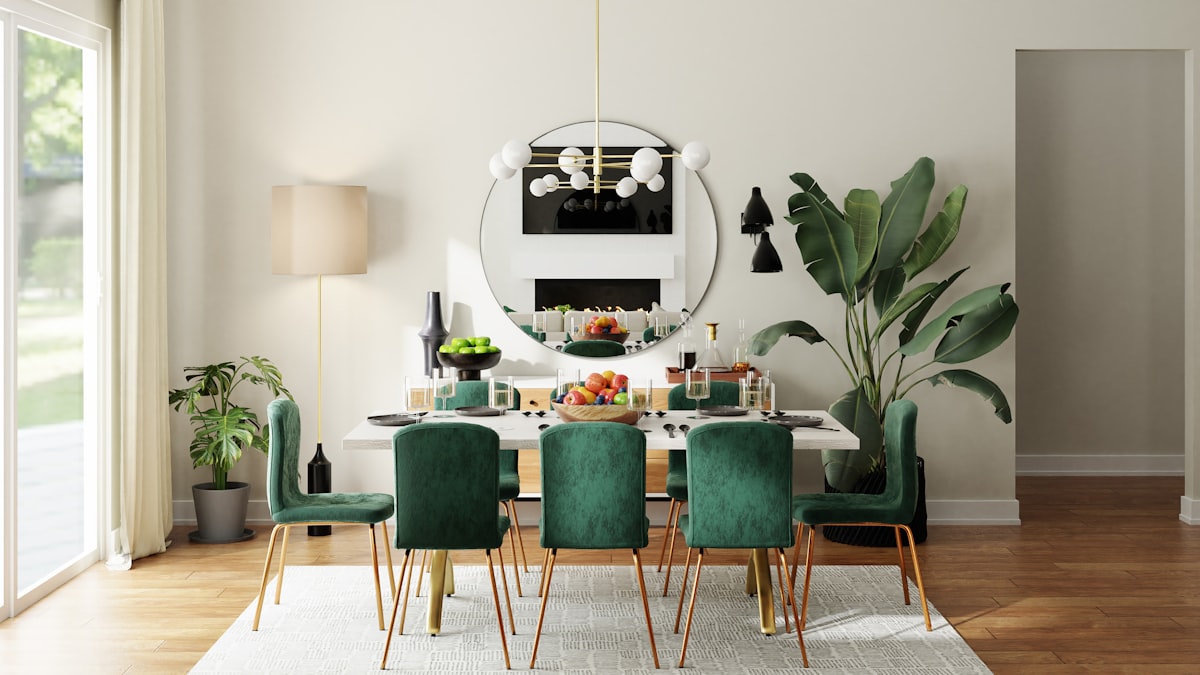
A mirror on a dining room wall does two things: it reflects the table setting (doubling the visual warmth of a candle-lit dinner) and it bounces natural light deeper into the room.
Placement guidelines:
- Hang a large mirror on the wall opposite the biggest window to maximize reflected light
- Position the center of the mirror at standing eye level (around 57 to 60 inches from the floor) if the wall is visible from adjacent rooms
- If the mirror is only seen from the table, sit-test it the same way you sit-test art
- In small dining rooms, an oversized mirror (even a leaning one against the wall on a console or sideboard) immediately makes the space feel more open
Avoid hanging mirrors where they reflect a cluttered kitchen counter or a blank ceiling. What the mirror shows matters as much as the mirror itself.
Wallpaper as a statement
Dining rooms handle wallpaper well because the walls tend to stay dry, and the room is used intermittently, so patterns do not wear out their welcome the way they might in a space you sit in for eight hours a day.
Patterns worth considering
- Oversized botanicals: Large-scale leaf or floral prints in muted tones (olive, dusty rose, warm gray) feel sophisticated without being busy
- Grasscloth texture: Not technically a pattern, but the woven texture adds warmth and depth. It works as a full-room treatment or a single accent wall
- Geometric line patterns: Thin lines in a subtle metallic or tonal color add structure without overwhelming the tablescape
- A decorative mural: A large, focused wall piece (landscape or architectural) turns an entire wall into a conversation piece
Peel-and-stick for renters
Removable wallpaper has improved significantly. Current adhesives leave clean walls on removal, and print quality rivals traditional paste-up options. Install it on the wall most visible from the main entrance to the room for maximum impact with minimum material.
Browse botanical peel-and-stick wallpaper and read listed roll coverage against the one wall you will actually finish.
Budget DIY projects under $50
Not every wall upgrade needs a professional. These projects use materials available at any hardware store.
Woven basket wall
Thrift stores and online marketplaces sell woven baskets for a few dollars each. Collect five to seven in varying sizes and textures. Arrange them on the wall using small nails or adhesive hooks.
The organic shapes and neutral tones add warmth without competing with the table setting. Total cost: usually under $30.
Floating shelf display
Two or three floating shelves (10 to 12 inches deep) installed above a sideboard create a layered display area. Group items in odd numbers: a small plant, a ceramic vase, and a framed photo. Or a stack of cookbooks, a candle, and a small sculpture.
Avoid overcrowding. Leave a visible pause on each shelf. A “leave 30 percent empty” line is a blog habit, not a measurement this desk can defend. If a guest would call it storage, take something off. The same retrieval-and-pause edit on a taller case is in bookshelf styling guide.
Browse 12-inch-deep floating shelves and check listed depth against the sideboard projection so plates still pass.
DIY picture-frame molding
Thin decorative trim (available in 8-foot lengths for $3 to $6 per piece) can be cut and glued to a wall in rectangular patterns to mimic panel molding. Paint the entire wall, trim included, in the same color. The raised rectangles catch shadows and create a classic architectural detail.
This works best on walls with no windows, where the full pattern stays uninterrupted.
Painted half-wall
Tape a line at 32 to 36 inches from the floor and paint the lower portion a deeper shade than the upper wall. This two-tone approach is the fastest way to add visual weight to a dining area without installing anything. It also makes ceilings feel taller.
Holiday-scale tables under the same walls are in holiday table decorating ideas.
Choosing what works for your room
The right wall treatment depends on what is already happening in the room.
| Room Situation | Best Wall Treatment |
|---|---|
| Open-plan dining area | Accent wall (paint or wood slats) to define the zone |
| Small dining room | Large mirror + light gallery wall to add depth |
| Formal dining room | Wallpaper or wainscoting for architectural presence |
| Casual eat-in kitchen | Floating shelves or basket wall for texture |
| Rental | Peel-and-stick wallpaper (see our apartment budget decorating guide) |
Start with one wall. The wall directly behind the head of the table is almost always the strongest candidate because every guest faces it. Once that wall has presence, the rest of the room catches up.
If the ceiling is the empty plane, beam options are in ceiling beams: styles and install tips.
Sources
- Dining rooms hang slightly lower than standing gallery height: Artfully Walls, How High Should Pictures Be Hung?
- Standing 57-inch center, 2–3 inch spacing, furniture-width shop filter: Gallery Wall Layout Ideas
- No-nail path for the same grouping: No-Nail Gallery Wall